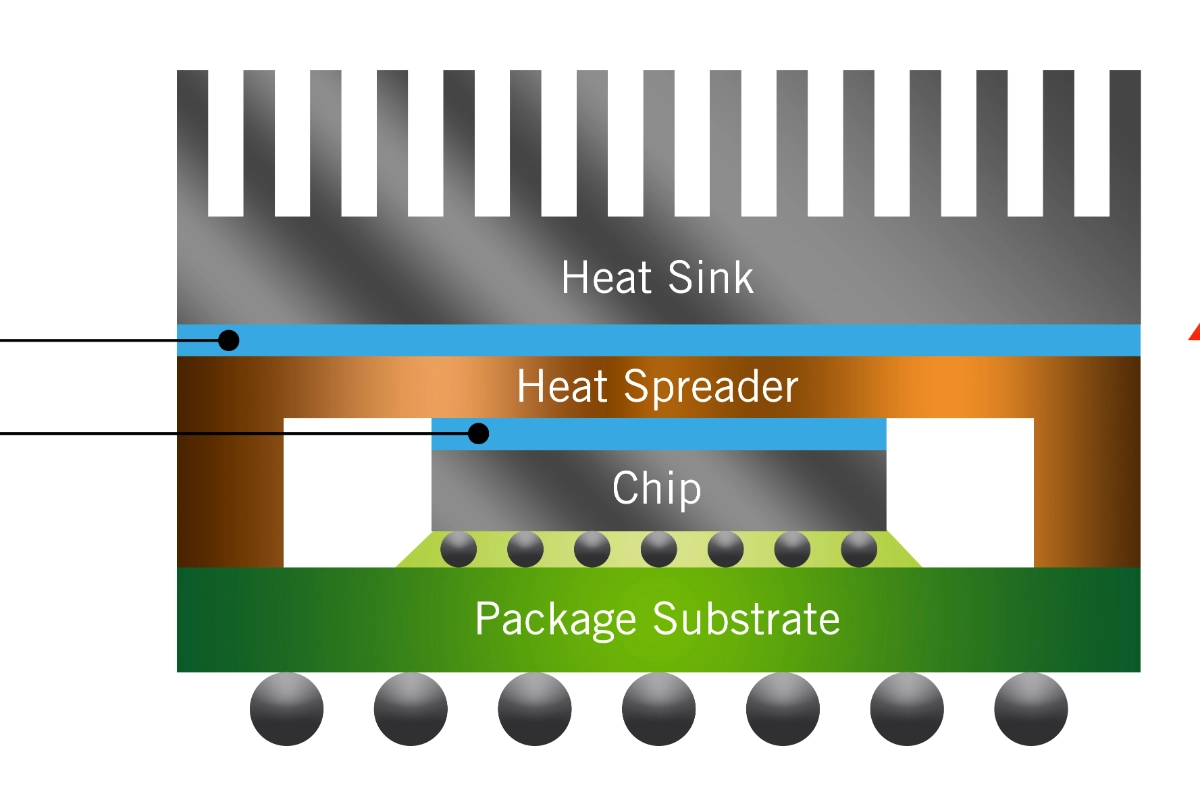
In today’s rapidly evolving electronics landscape—driven by AI applications, high performance computing, and advanced communication systems—thermal management has become a critical enabler of performance and reliability. At the heart of this challenge lies one fundamental concept: thermal spreading.
Key to effective thermal spreading are Thermal Interface Materials (TIMs)—specifically, TIM1, TIM2, and the increasingly important TIM1.5. Understanding how these materials work, and where to apply them, is essential for engineers working in semiconductor packaging and system-level design.
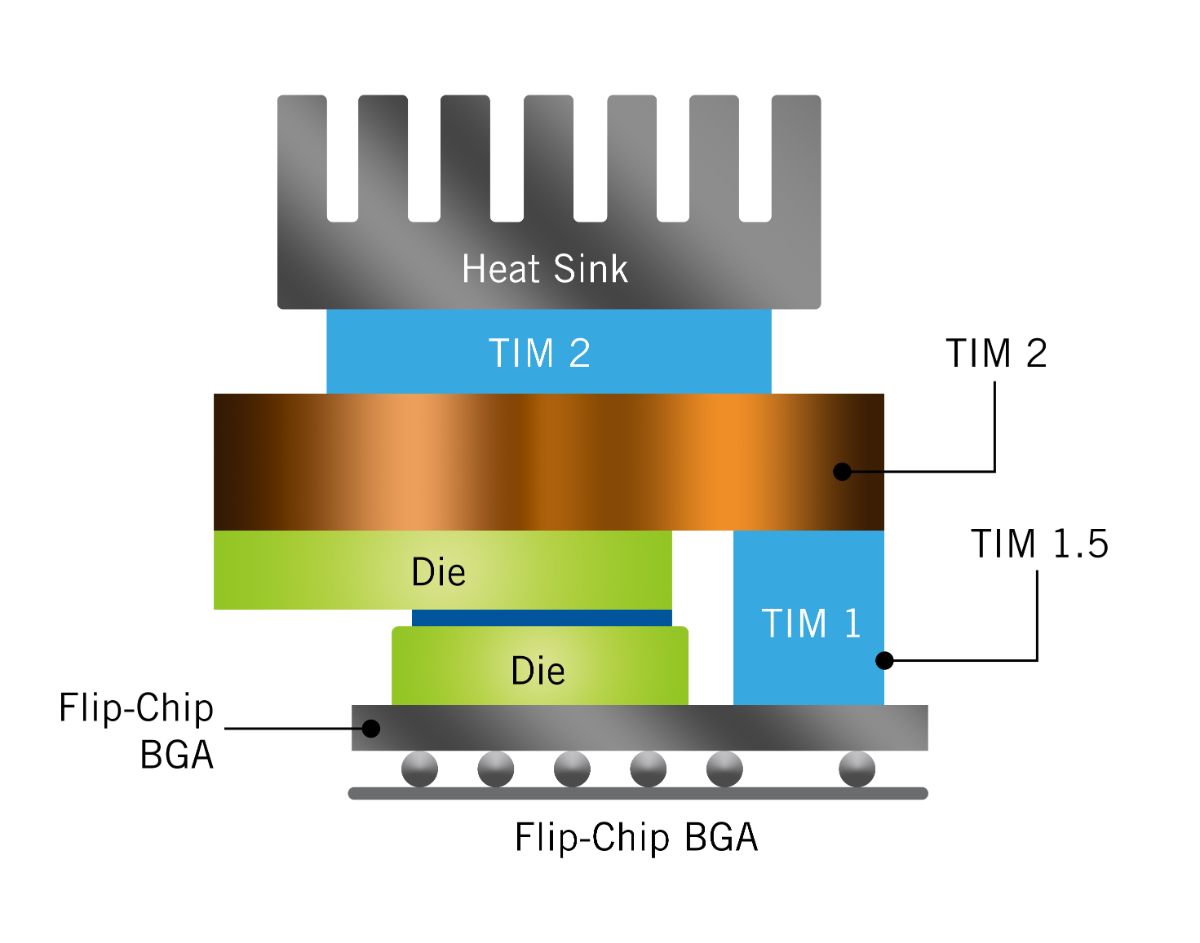
What Are TIM1, TIM2, and TIM1.5?
| Types of TIM | TIM 1 | TIM 2 | TIM 1.5 |
|---|---|---|---|
| Stage of heat transfer path in modern electronics | Positioned between the semiconductor die (e.g., CPU, GPU) and the integrated heat spreader (IHS). It plays a vital role in transferring concentrated heat away from the silicon with minimal thermal resistance. | Bridges the IHS and external heat sinks such as fans, vapor chambers, or cold plates. Its primary role is to extend the heat transfer from the package to the overall thermal management system | Used in lidless package designs, where the bare die interfaces directly with the heat sink. This configuration is becoming more common in high performance computing and AI applications due to the extremely challenging stress release and heat dissipation requirements. |
| Common TIM Materials by Type | Silicone thermal gels, indium preforms, silver-based adhesives, graphene sheets | Advanced greases, thermal pads, gap filler gels, graphene sheets | Advanced greases, phase change materials, graphene sheets, liquid metals |
Key Differences: Performance and Use Cases
| Types of TIM | TIM 1 | TIM 2 | TIM 1.5 |
|---|---|---|---|
| Thermal Conductivity and Spreading Efficiency | Requires extremely high thermal conductivity (4–80 W/m·K) to handle the intense heat density at the die level |
Typically operates at 2–7 W/m·K, providing adequate conductivity as heat is already partially spread by the IHS. |
Balances performance needs with mechanical protection, delivering 8–20 W/m·K based on the application. |
| Mechanical Stability and Contact Resistance | Must exhibit excellent surface conformity and low contact resistance to fill micro-scale voids between the die and the IHS | Must perform consistently across temperature cycles and long-term operation in compact electronics |
Expected to protect the delicate bare die while maintaining efficient heat transfer and mechanical stability in AI hardware and dense HPC systems. |
Why TIM Selection Matters in Semiconductor Packaging
In semiconductor packaging, TIM selection is not one-size-fits-all. Engineers must factor in:
- Chip power density
- Thermal spreading requirements
- Package geometry and footprint
- System-level cooling methods
- Reliability under reflow cycles and thermal stress
TIM1 and TIM2 remain the default in traditional lid-based packages. However, with the rise of AI-driven electronics and lidless architectures, TIM1.5 is quickly becoming essential for next-gen cooling
Heraeus Electronics Innovation: Thermal Management for
Next-Gen AI and HPC
To support this shift, Heraeus Electronics has introduced a cutting-edge TIM1 solution with thermal conductivity exceeding 30 W/m·K. This advanced material:
- Does not require backside metallization on the die or lid
- Maintains low voiding and high stability across multiple reflows
- Is ideal for AI applications and high performance computing systems where thermal load is extreme
We’re also actively expanding our TIM1.5 portfolio to address the thermal and mechanical challenges of next-gen lidless packaging in AI servers and dense data center applications.
Ready to Optimize Your Thermal Design?
From advanced thermal spreading materials to custom solutions for semiconductor packaging, Heraeus is helping electronics innovators stay ahead of the curve.
Contact us today to learn -
How our TIM technologies can improve performance, reliability, and
integration in your next design.
Heraeus Electronics SingaporeNo. 26 Pioneer CrescentSingapore 628558Singapore