What is the difference between sintering and soldering in power modules?
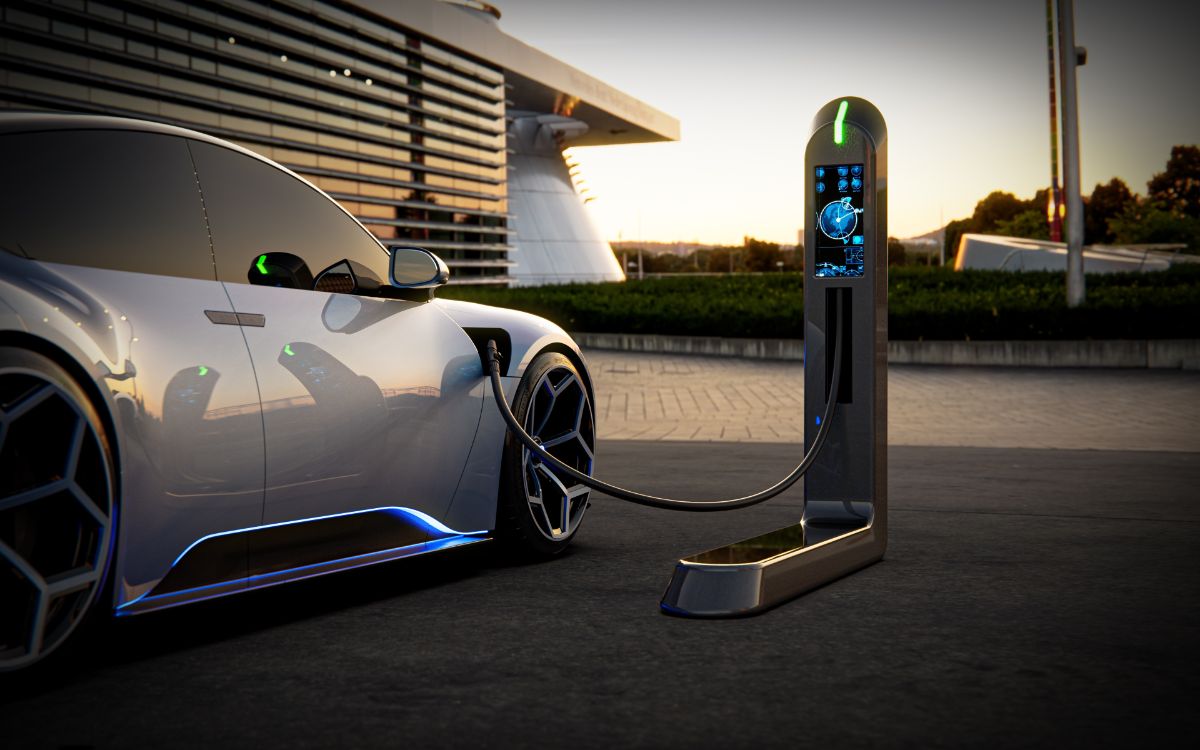
The rise in high-voltage electric vehicle (EV) architectures is placing increasing demands on power module designs and automotive inverters. As systems accelerate beyond 800V, and silicon carbide (SiC) inverters become more popular, EV engineers must decide which semiconductor packaging delivers the optimal balance of thermal and mechanical performance, reliability, and cost efficiency for their needs.
The two main options for attaching power modules to heatsinks are soldering and sintering. Traditionally, soldering has been the most popular choice as a lower-cost solution to support mass-market EV adoption. However, when it comes to attaching SiC dies in high-power EV inverters, sintering has become the established process. Both soldering and sintering offer advantages and considerations that must be evaluated against application requirements.
When should engineers choose sintering over soldering?
Sintering is used to attach modules in high-end vehicles like Tesla that use the TPAK power module. Large area sintering (LAS) has emerged as an effective solution for SiC chips above 175ºC. Replacing a soldered base plate or soldered die attach by sintered interconnects can reduce maximum die temperature by more than 10ºC, doubling the lifetime of the die. Consequently, a fully sintered module is expected to last four times longer than a fully soldered one.
Sintered modules can withstand significantly higher junction temperatures without degradation. Thermal cycling tests show they can withstand more than 2,000 cycles between −50°C and +150°C with minimal delamination or voiding.
Because sintered silver materials don’t melt during processing, they maintain structural stability at temperatures exceeding those tolerated by solder-based systems.
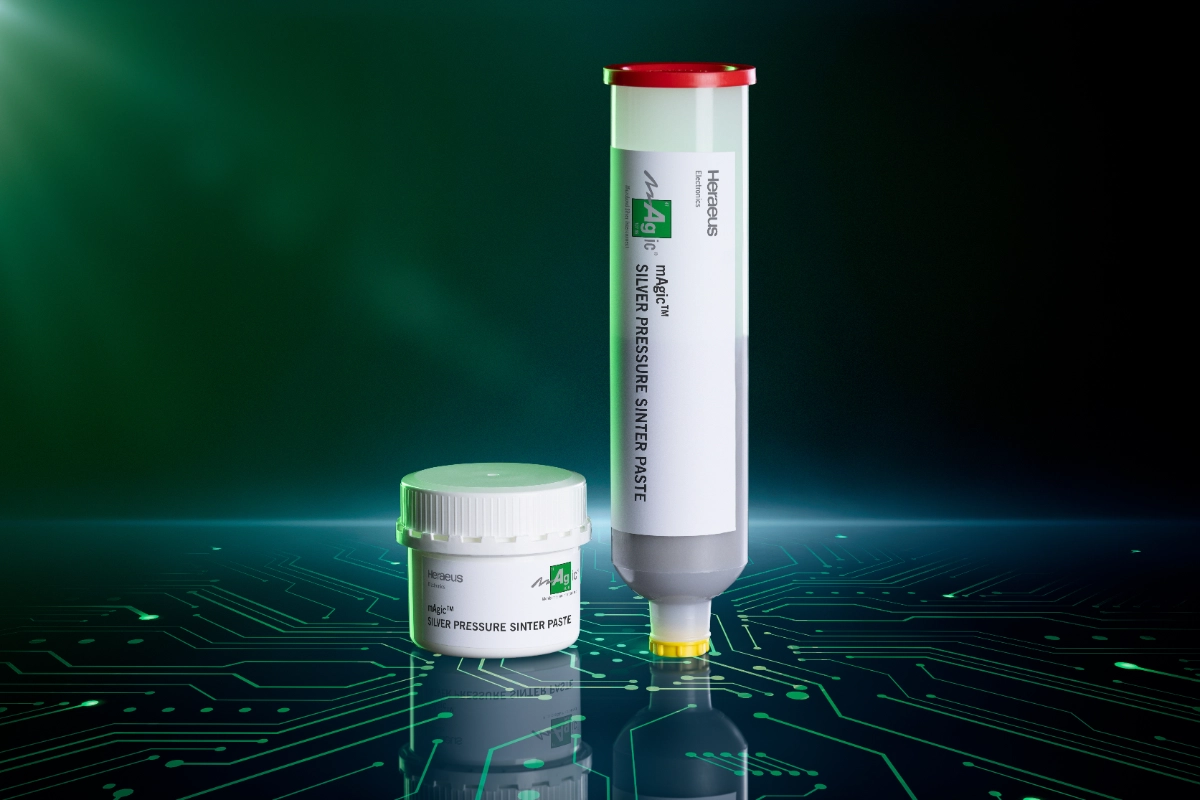
To advance module attach sintering, Heraeus Electronics developed the mAgic® PE360 sinter paste as PE360P for printing and PE361D for dispensing.

The paste, which has been successfully qualified in automotive projects, won the "2025 Global Technology Award" in the Thermal Interface Materials category.
It enables high bond strength with relatively low process parameters (typically five minutes at around 200°C under moderate pressure).Unlike conventional sintering materials that require high pressure and complex handling, PE360 enables sintering at low pressure and low temperatures. The low sintering parameters also enable the fastening of pre-assembled components and encapsulated modules with optimal, void-free attachment.
What are the benefits of solder preforms for EV power modules?
For mass-market EVs, soldering offers a great balance between cost and performance. It is more than 10 times cheaper than silver-paste sintering and the placement of preforms is more straightforward than printing.
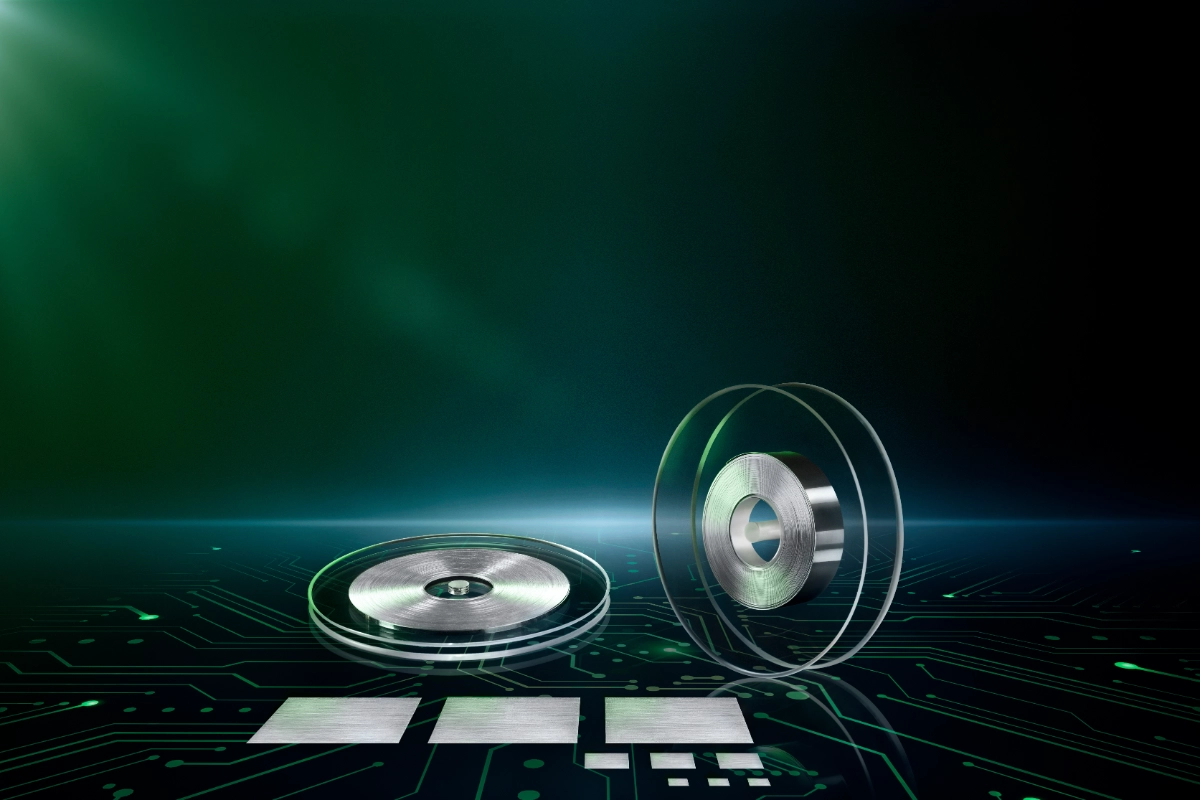
Highly reliable solder materials, such as Heraeus Electronics’ Microbond® with Innolot® alloys, give good strength and fatigue resistance at a low cost. Innolot® solder joints have exceptional resistance to fatigue and minimal voiding, even after 1,000 thermal cycles between −40 °C and +125 °C.
Solder preforms have a lower thermal conductivity than sinter (less than 65 W/mK, compared to over 200 W/mk for silver or copper sintering). However, the driving temperature of 175ºC for SiC chips is a struggle for soldering, because it is close to melting temperatures. Melting temperatures for standard tin-silver-copper (SAC) alloys are 217ºC - 220ºC and for Innolot® 206ºC-218ºC). As a result, soldering is generally optimised for applications where cost and scale are prioritised over thermal performance. For a detailed technical comparison of sintering versus soldering,
Should I choose sintering or soldering for EV power modules?
The decision about whether to choose silver sintering, copper sintering or soldering isn’t about which is better; it’s about which is right for your application. Sintering gives engineers unmatched thermal and mechanical reliability, but soldering provides manufacturing scalability and cost efficiency.
Both choices raise another key consideration: for vehicles to be sustainable, they must remain on the road long enough to offset the emissions generated during manufacturing. This shifts the conversation from building more vehicles to building vehicles that last - and doing so through smarter material and design choices.
As EV inverter requirements evolve, choosing the right advanced packaging material becomes increasingly critical. Heraeus Electronics can help you find the best solution to alleviate your power struggle. We provide a comprehensive portfolio of sintering and soldering solutions, supported by engineering services for validation and optimisation.