The Hidden Cost of Process Complexity
When selecting thick film materials, engineers naturally focus on electrical performance, adhesion, and long-term reliability. These characteristics remain essential, but they are only part of the equation.
Every additional firing cycle also requires furnace capacity, operator handling, inspection, cooling, and production scheduling. While each activity may seem minor, together they create hidden costs that become increasingly significant in high-volume manufacturing.
Rather than asking how to make every firing cycle faster, a different question should be asked:
Is every firing cycle necessary in the first place?
This shift in thinking changes the focus from optimizing individual process steps to improving the overall manufacturing process.
Removing Process Steps Through Co-Firing
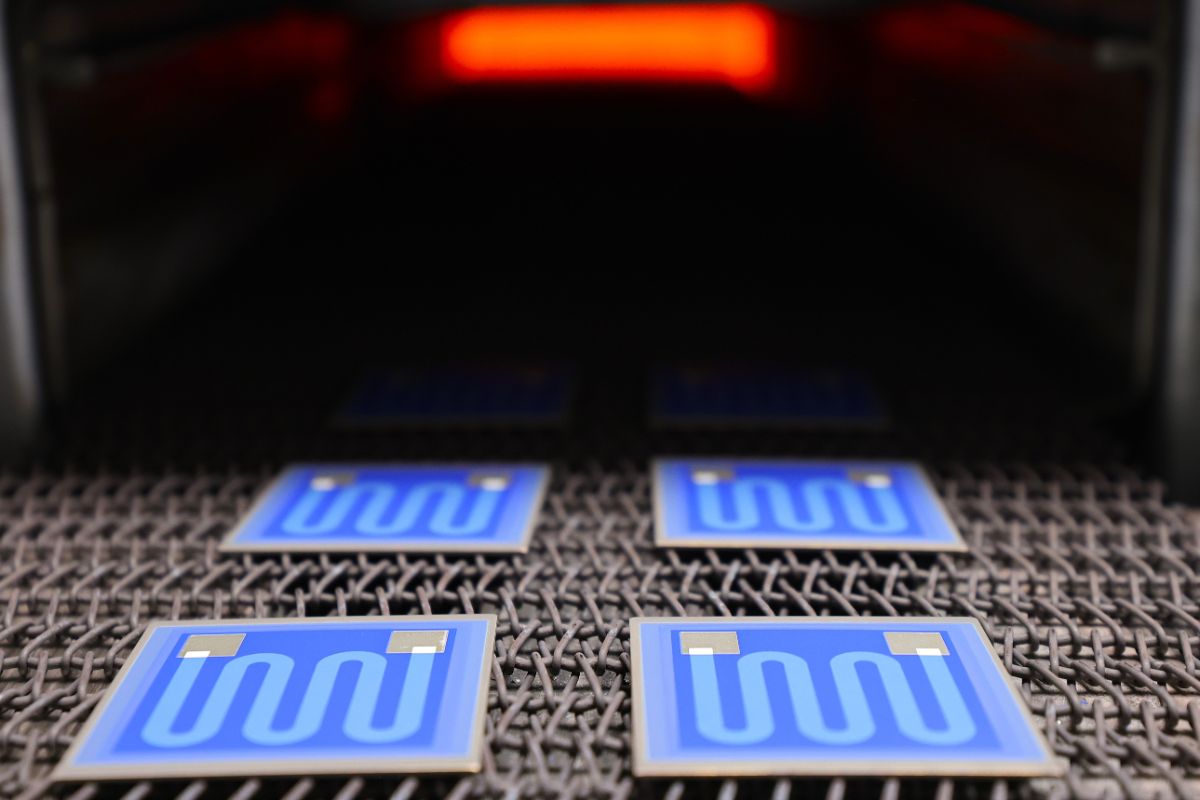
Traditional thick film heater production often requires each functional layer to be printed, dried and fired before the next layer can be applied. Repeating this sequence multiple times increases production time and introduces additional opportunities for variation.
Co-firing is enabled by compatible material systems that allow multiple functional layers to share the same firing cycle. In the process described here, Heraeus Electronics' SD1015 is used as both the dielectric and encapsulation material enabling multiple layers to be co-fired within the same thermal event, while SR2X resistor pastes and SC1001 conductor can be processed within consolidated firing cycles.
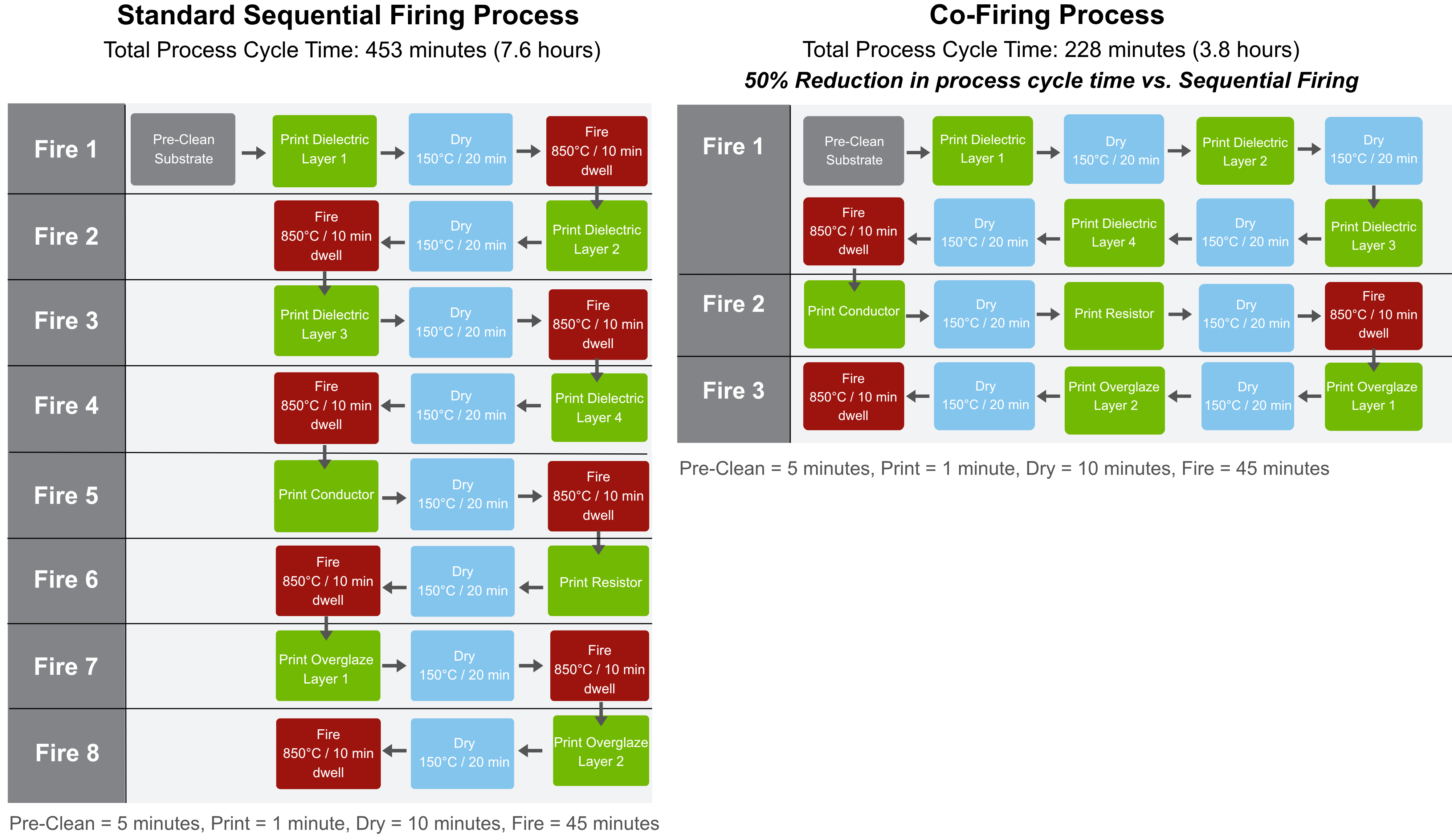
This reduces the manufacturing process from seven or more furnace passes to just three, reducing the total process cycle time by up to 50%.
Process Flow of Standard Sequential Firing vs. Co-Firing
From Process Simplification to Lower Total Cost of Ownership
The true value of co-firing extends well beyond a simplified process and reducing the number of furnace passes. It changes the economics of the manufacturing process.
Every eliminated firing cycle removes more than a thermal process, it also reduces handling, inspection, cooling time, and demand on production resources. Components spend less time waiting between operations and more time moving through the factory, helping improve throughput without increasing production capacity.
These individual improvements may appear incremental, but together they have a compounding effect. Less work in progress, better equipment utilization, reduced energy consumption, and shorter production cycles all contribute to lower manufacturing costs per part.
Rather than investing in additional equipment to increase output, manufacturers can unlock greater productivity by simplifying the process itself.
Less Waiting, More Manufacturing
Co-firing represents more than a materials capability. It is an opportunity to rethink the manufacturing process by reducing complexity, improving throughput and lowering total cost of ownership.
If you're looking to optimize your thick film heater manufacturing process, our application experts can help you evaluate whether co-firing is the right approach for your next design. Contact us to learn more!